Showing posts with label technology. Show all posts

Saturday, June 15, 2013

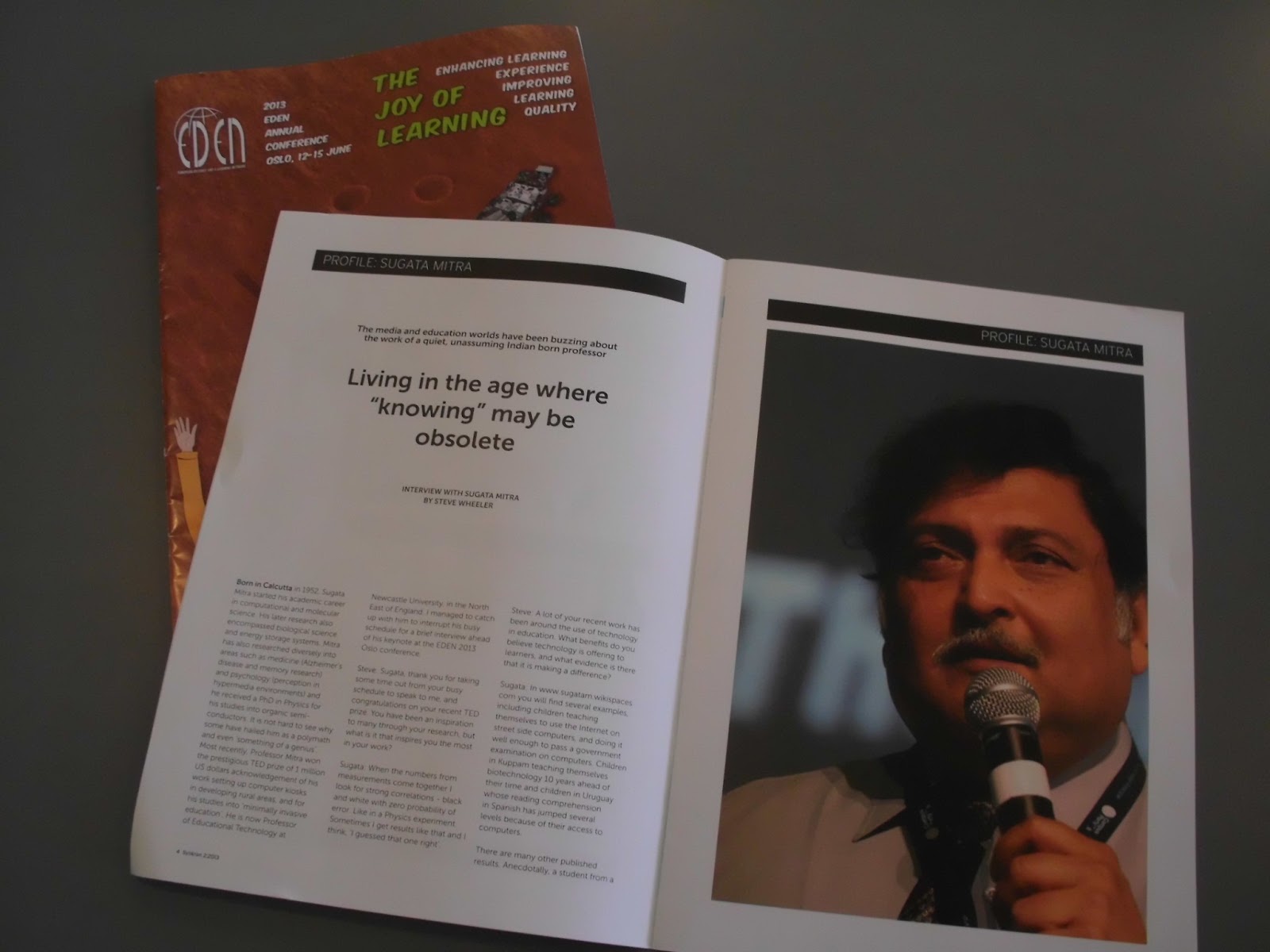
Sugata Mitra - Charlatan or genius?

'It's quite fashionable to say that the education system is broken - it's not broken, it's wonderfully constructed. It's just that we don't need it any more. It's outdated.'

These are the radical thoughts of Professor Sugata Mitra, the doyen of innovative education and a figure of some controversy. Sugata Mitra recently won a $1 million TED prize to develop his ideas around his 'School in the Cloud' and building on his notion of minimally invasive education. Mitra told me the phrase 'minimally invasive education' came from his interest in medical procedures, where keyhole surgery was the least invasive method for surgical intervention, and caused the least amount of trauma.

What if, he argued, we could do the same thing with education? Well, many people now know the answer to that question, because he has disseminated his findings, and whatever the detractions and arguments against the Hole in the Wall projects, it has to be said that this bold experiment has some striking outcomes. Not least, claims Mitra, children when left to their own devices (in this case a computer screen and touch pad mouse in a wall) and when they are in small groups, children will teach themselves an extraordinary amount of new skills and knowledge. Whatever your views on this shade of auto-didacticism - and there have been some vociferous criticisms, do watch the video interview I did with him at this year's EDEN conference, and then make your own mind up. Is he a charlatan, or a genius?


Photo by Steve Wheeler

Creative Commons License
Sugata Mitra - Charlatan or genius? by Steve Wheeler is licensed under a Creative Commons Attribution-NonCommercial-ShareAlike 3.0 Unported License.

Friday, June 14, 2013

Bubbles

Bubbles by Stellajo1976, on Flickr
Creative Commons Attribution 2.0 Generic License  by Stellajo1976

Day 2 of the conference ended in a euphoric high with the closing keynotes. However I would like to take a step or two back and reflect on a remark from a session I attended. There's been a lot of talk about tsunamis, revolution, disruption and other radical terms of major upheaval in education. But let's just remember that we've been here before several times.

At the end of the 1990s the dotcom boom was in full flight and e-learning was on everyone's lips. It was going to completely change the education system and large scale online universities started springing up all over the world and established universities rushed to start offering online courses and degree programmes. Then came the crash and online learning got more integrated into the traditional system and we returned to business as usual, though with a few new elements and a few lessons learned. The system got a fright but then the innovations were absorbed and the threat of revolution was averted.

Don't get me wrong, I believe that we are in a period of exciting change and see the promise of a new focus on learning with technology as a powerful tool. But I also think it's dangerous to underestimate the power of tradition and that we're challenging established business models that will fight back. Already the openness of the mainstream MOOC market is being diluted as they develop into franchising deals for digital course material with full copyright on everything. The truly open and innovative initiatives such as OER University, Peer 2 Peer University and the original connectivist MOOCs are virtually never mentioned though they all continue to operate within a limited but enthusiastic and creative community.

We need to feel inspired and euphoric as we did yesterday but we also need to question and test our ideas critically. We need to remember not to put too much trust in big name companies whose aim is of course to provide return on investment. Coursera and all the others are still evolving and the model is clearly that of freemium, not free. You give away a bit for free to persuade people to buy the premium version. Let's remember the past and beware of bubbles.

Thursday, June 13, 2013

What is it about games...?

Just what is so special about games playing? Why is it so popular with all ages? And what is it that divides opinion so deeply about whether games have a place in the curriculum? Never has there been so much opportunity for schools, colleges and universities to capitalise and exploit the power of games to inspire, engage and enliven learning. And yet any straw poll taken amongst any group of teacher will reveal some strong polemic views. Some teachers extol the virtues of any game, and claim that all games have the potential to support learners as they acquire new skills, problem solving abilities and knowledge gain. Others argue equally strongly that games have no place in the classroom, because they are distracting, take students off task, and that there is no empirical evidence to support the argument that they contribute anything significant to the learning process. I have personally nailed my colours to the mast with several recent blog posts including The games we play and The future of gaming. Earlier today at the EDEN Conference, here in Oslo, I took part in a special session on games based learning.

I presented a paper co-written with one of my students, Lucy Kitching, (@lmkitching) which had originally been her third year research dissertation. Lucy's project set out to investigate whether games consoles have a positive impact on primary school girls' motivation and learning. She found that there are strong correlations between playing games consoles at home and the expectations of playing games in school for learning purposes. She also showed that there were (in the UK schools she studied) a significant shortfall in the provision of games consoles in comparison to those available in the average home. Whilst these findings might elicit a 'so what?' from some readers, the results of her study nevertheless indicate how current contexts can affect the motivation of learners to engage in learning with games consoles in formal education settings.

The second paper, presented by Marie Maertens (Katholieke Universiteit, Leuven, Belgium) showcased some research done into instructional design approaches in games. Marie spoke about adaptive and adaptable game-play and how games can be designed to respond to the individual needs and preferences of learners. She concluded that with the conceptual framework that the team have developed at KU Leuven, it is now possible for the creation of games that are based on valid measurements of student performance, and adaptive mechanisms that will respond to changes learners experience in their knowledge and skills more or less as they occur.

The final paper in the session was from Anne-Dominique Salamin (HES-SO, Switzerland) who continued the theme of adaptive games. Her paper, entitled 'New Tools for Students' also featured a live demonstration of a virtual world within which a variety of different decision making scenarios could be presented. Students were rewarded throughout the game by credits which they could then 'spend' to improve the graphical environment within which they were working. As an added touch, occasional and random insects walked across the screen to be targeted by the learner. One delegate tweeted during the event that they had never before witnessed such a bizarre occurrence at a conference - several professionals in unison shouting out 'kill that insect!'

The discussion that followed was productive and discursive, covering such areas as student expectations, constraints of games based learning, teacher and parent objections and design features and graphic rendering speeds in educational games.

Photo by Steve Wheeler

Creative Commons License
What is it about games...? by Steve Wheeler is licensed under a Creative Commons Attribution-NonCommercial-ShareAlike 3.0 Unported License.
The kids are all right

This morning, here in Oslo, it was all about the kids. And why not? Too often we gather to discuss education, to expound on learning theories and to congratulate ourselves for our pedagogical prowess, and yet we miss the crucial element, the context which should be central to everything we do. The learner. Where is the learner voice at learning conferences? This was addressed today at EDEN, and I'm glad I was there to witness it. Kids are generally honest in their opinions, so if you want to know how well a school is doing, ask them. Ask them out of earshot of the teachers, and off the record, and they will tell you.

During the plenary opening session we heard from several frank young students about their experiences at school. It was not good news for the Norwegian education system. One student said 'I don't want my own children to experience what I went through at school'. Another opined 'The way school is structured doesn't enable students to find each other. It is too structured'. A third simply said quite bluntly 'school is boring'. I would image that the same sentiments could be expressed by school learners the world over. It's important to qualify these comments in the context of this year's EDEN Conference, the title of which is: ' The Joy of Learning: Enhancing Learning Experience, Improving Learning Quality.'

Why are students' experience so poor in most state run schools? Friedrich Nietzsche once suggested that education in state run schools is bad for the same reason cooking in large canteens lacks quality. One size patently does not fit all, and one of the students highlighted this, calling the standard student 'a myth'. He was right, and this message resonated around the auditorium. We have been teaching this way in schools for years, and it is about time it stopped, was their message. It was a refreshing start to the event, one that challenged us all, and made us think about the future of education. 

The rest of the conference will now have to - be required to - focus on what we need to do to change the current situation in so many schools around this planet. What will we do to make lessons 'less boring'? More importantly, what can be done to ensure that learners are more engaged? Children cannot vote with their feet in compulsory education, but they can vote with their minds. If we as teachers, are not in the game, and do not convey enthusiasm, inspiration and excitement to our students, how will they become engaged? How can we turn them on to studying serious subjects, if we cannot get ourselves enthusiastic in the first place? How will technology supplement and support these processes? Is learning changing, and if so, what will need to be the changes we will have to make to accommodate these changes? 

Read this blog over the next few days, and we as a blogging team will report to you from EDEN on what is being said, discussed, explored... and promised.... for the future of education.

Photo by Steve Wheeler